Blog
How Do You Make a Dog Coat? Free Pattern and Step-by-Step Guide

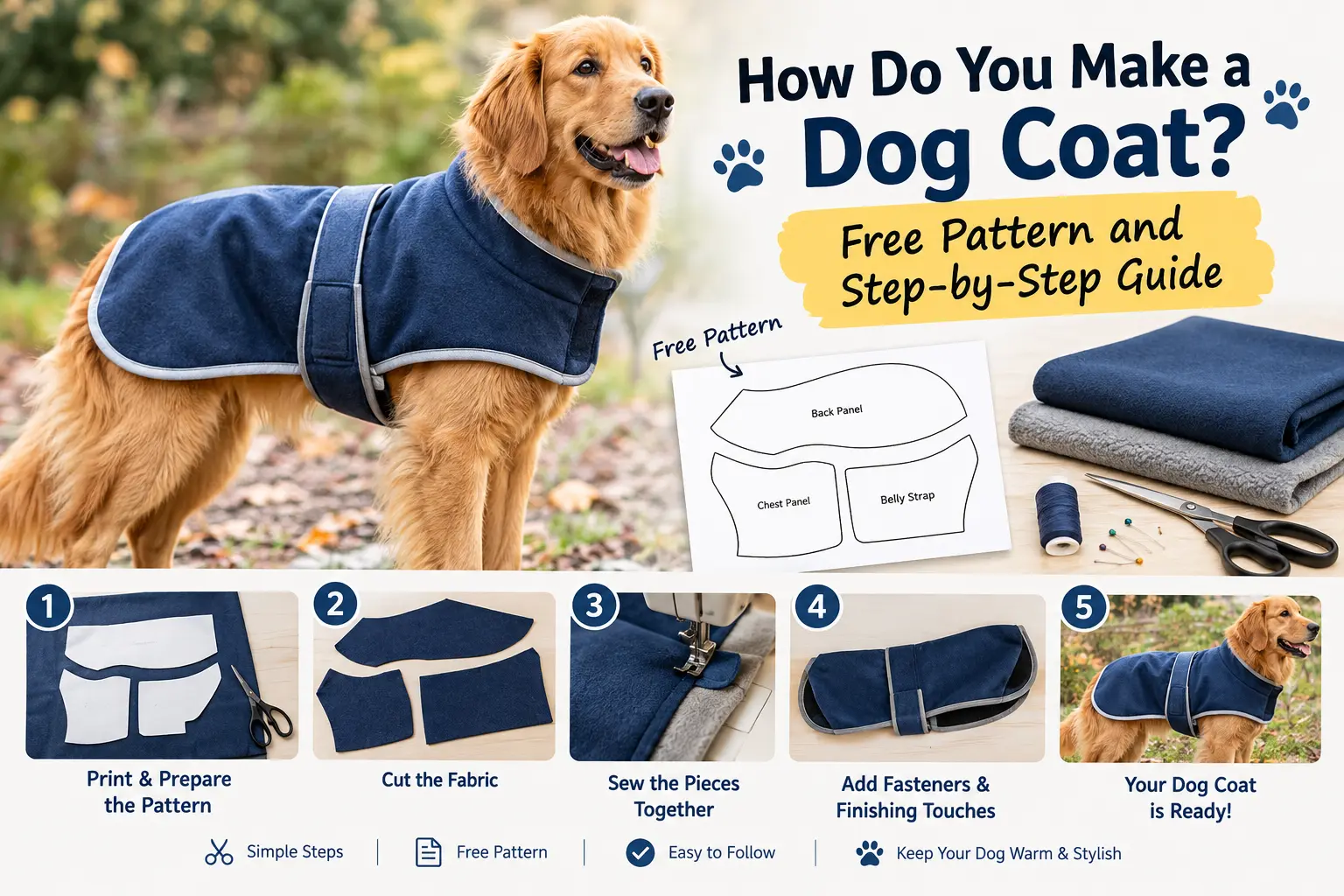
How do you make a dog coat that actually fits? Take three measurements, cut one simple shape from a dog coat pattern, and add two hook-and-loop straps. Most beginners finish their first coat in a single afternoon.
Store-bought coats are usually cut for an “average” dog, and very few dogs are average. A Dachshund has a long back, a Greyhound has a deep chest and a slim waist, and a French Bulldog is broad across the shoulders. When you sew your own, you fit the coat to the dog instead of forcing the dog into the coat.
At Groomer Outfitters, we know how much a good fit matters to people who work with dogs every day. This guide shows you how to draft your own pattern, where to find a free printable dog coat pattern pdf, and how to sew a dog coat from start to finish.
How to Make Jacket for Dog: The Short Version
- Measure your dog’s back length, neck and chest.
- Draft or print a pattern in that size.
- Cut one outer piece and one fleece lining piece.
- Bind the edges with bias tape.
- Sew on the hook-and-loop straps.
- Try the coat on and trim the straps for a snug fit.
The sections below explain each step in detail.
What You Need
| Item | Good choices | Why it matters |
| Outer fabric | Canvas, twill, denim, ripstop nylon | Durable and wind resistant |
| Lining | Fleece, flannel, sherpa | Adds warmth and softness |
| Closures | Hook-and-loop (Velcro) tape, 2.5 cm (1 in) wide | Adjustable and quick to fasten |
| Edging | Bias tape, 1.3 cm (½ in) wide | Hides raw edges, no hemming needed |
| Tools | Measuring tape, fabric marker, pins or clips, scissors, sewing machine, thread | Basic sewing kit |
| Optional | Reflective tape, D-ring or leash slit | Safer evening walks |
Most dogs need about half a yard (0.5 m) of each fabric. Large breeds may need up to a full yard.
A small tip from the workshop: fleece and flannel shed a lot of lint. A sturdy apron keeps your clothes clean, and the pockets hold your tape measure, marker and clips. Our [grooming aprons] work well for this, and you will find more workwear and accessories in the [Groomer Outfitters shop].
Step 1: Measure Your Dog
Ask your dog to stand naturally, and keep a few treats nearby. Take these three measurements:
- Back length: from the base of the neck (where the collar sits) along the spine to the base of the tail.
- Neck: around the neck where the collar sits. Leave room for two fingers.
- Chest: around the widest part of the ribcage, just behind the front legs. Leave room for two fingers here too.
Write the numbers down. Then use this table as a rough starting point. Breeds vary, so always trust your tape measure over the breed name.
| Size | Back length | Typical examples |
| XS | Under 25 cm (10 in) | Chihuahua, Toy Poodle |
| S | 25–35 cm (10–14 in) | Pug, Shih Tzu, French Bulldog |
| M | 35–48 cm (14–19 in) | Beagle, Cocker Spaniel |
| L | 48–60 cm (19–24 in) | Border Collie, Whippet |
| XL | 60 cm+ (24 in+) | Labrador, Golden Retriever, Greyhound |
Step 2: How to Make a Dog Jacket Pattern From Your Measurements
You don’t need a printer to get started. Grab kraft paper, newspaper or an old bedsheet and follow this method. It creates a reusable dog coat template that you can trace onto card stock and keep.
- Fold the paper in half. The fold is your dog’s spine.
- Along the fold, draw a line as long as your dog’s back length.
- Neck edge: measure out from the fold by (neck ÷ 4) + 1 cm (½ in) and mark a point.
- Chest edge: about one third of the way down the fold, measure out by (chest ÷ 4) + 4 cm (1½ in) and mark a point.
- Tail edge: at the end of the fold, measure out about two thirds of your chest point.
- Join the three points with smooth curves and round the tail corners.
- Add a 1 cm (⅜ in) seam allowance all around, then cut it out.
Worked example (Pug): back length 28 cm, neck 30 cm, chest 42 cm. The neck point is 8.5 cm from the fold, the chest point is 14.5 cm, and the tail point is roughly 9.5 cm. Unfolded, that gives a coat about 17 cm wide at the neck and 29 cm wide at the chest.
This is a starting draft, not a guarantee. Cut it once from an old sheet, pin it on your dog, and adjust before you touch your good fabric.
How to Find Good Free Dog Clothes Patterns
Type template easy free printable dog clothes patterns or beginner diy dog clothes patterns into a search engine and you will get thousands of results. Not all of them are worth your fabric. Here is how to sort them.
What to look for:
- A size range that covers your dog’s measurements
- A test square so you can check the print scale
- Seam allowances already included
- Clear instructions for the closures
- Photos or a video, if you are new to sewing
Search phrases that help:
- Start broad with free dog clothes patterns, then try free dog clothes patterns pdf when you want a file for your home printer.
- Free dog sewing patterns and sewing patterns for dog clothes free often lead to independent sewing blogs.
- For coats, try free dog coat sewing pattern, dog coat pattern free or free dog coat patterns to download.
- For jackets, try dog jacket pattern free or dog jacket sewing pattern free.
- Add dog sewing patterns free printable if you want something ready to print and cut.
If you choose a paid pattern, a simple dog coat sewing pattern or dog jacket pattern with one main piece and two straps is the easiest place to start.
Step 3: Cut Your Fabric
- Pin your pattern to the outer fabric with the spine edge on the fold, and cut it out.
- Repeat with the lining fabric.
- Cut two belly straps and one neck strap from spare outer fabric. About 5 cm (2 in) wide is a good size. Each belly strap should be long enough to reach under the belly with about 5 cm (2 in) of overlap. You can trim them later.
Step 4: How to Sew a Dog Coat
- Layer the fabric. Place the lining and outer piece wrong sides together and pin or clip them. Sew a line of stitches 5 mm (¼ in) from the edge to hold them together.
- Bind the edges. Fold the bias tape over the raw edge and stitch it down. Stretch it very slightly around the curves so it lies flat.
- Make the straps. Fold each strap in half lengthwise, sew along the open edge, and turn it right side out.
- Add the hook-and-loop tape. Sew the soft loop side to one end of each strap. Sew the rough hook side to the coat so it faces away from your dog’s skin and fur. Rough hooks can snag hair.
- Attach the straps to the lower edge of the coat, at the chest and neck.
- Try it on. Fasten the straps, check the fit, and trim any extra length.
Want it warmer? If you are wondering how to sew a dog jacket for winter walks, add a layer of thin quilt batting between the outer fabric and the fleece lining before you bind the edges.
Step 5: Check the Fit and Safety
- You should be able to slide two fingers under the straps.
- Your dog should be able to sit, lie down and squat comfortably.
- The coat should end at the base of the tail and not cover the back legs.
- Leave access for a harness or leash. A small reinforced slit near the shoulders works well.
- Skip buttons, dangling ties and loose trims that a dog could chew off and swallow.
- Take the coat off indoors, and never leave a dog wearing one unsupervised.
Not every dog needs a coat. Short-haired, thin, senior and very small dogs benefit the most. Thick double-coated breeds usually don’t. If you are unsure, ask your vet.
Beyond the Coat: More Projects to Try
Once you have made one coat, the same skills open up plenty of new ideas.
Dog vest. A dog vest pattern is a coat pattern with shorter, less wraparound side panels. To turn the coat you drafted into a dog vest template, trim the side edges up, cut a leash opening and close it with a single strap.
Pajamas. A free dog pajama sewing pattern usually calls for stretch fabric such as cotton jersey. Use a stretch stitch or a narrow zigzag so the seams don’t pop.
T-shirts. A free dog shirt sewing pattern is a great way to recycle an old T-shirt. Cut carefully around the logo if you want to keep it.
Puppy clothes. Puppies grow fast. Look for puppy clothes patterns free with adjustable closures, and re-measure every few weeks.
Tiny breeds. For Chihuahuas and Toy Poodles, patterns for dog coats small should include narrow chest sizes and short back lengths.
Costumes and extras. When you’re ready to experiment, browse free dog outfit patterns for bandanas, raincoats and costumes, and free dog apparel patterns for hoodies and sweaters.
Ready to Make Your First Dog Coat?
You now know how do you make a dog coat, from measuring to the final stitch. Start with a paper test, pick your fabric, and enjoy the fit only a handmade coat can give.
When you’re ready to sew, put on a good apron and gather your tools. Browse the [grooming aprons] and [other essentials] at Groomer Outfitters, and [download the free dog coat pattern PDF] to get started.
Frequently Asked Questions
How much fabric do I need for a dog coat?
Half a yard (0.5 m) each of outer fabric and lining is enough for most dogs. Large breeds may need up to a yard.
What is the best fabric for a dog coat?
Choose water-resistant ripstop nylon, canvas or twill for the outside, and fleece for the lining. For everyday indoor use, cotton flannel is soft and easy to wash.
Can a complete beginner do this?
Yes. A one-piece coat with straight seams and bias tape edges is a good first sewing project.
How tight should a dog coat be?
Snug enough not to slip, loose enough to slide two fingers underneath.
How do I wash a homemade dog coat?
Pre-wash all fabrics before sewing so they don’t shrink later. After that, machine wash on a gentle cycle and air dry.